BLUE MORPH:-
 General Body Form:
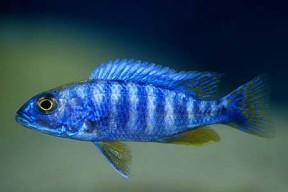
Long and thin for an Mbuna, the body is very slender. The males are Blue with dark bars and females are pale yellow with a hint of blue and sport a nice black dorsal fin.
Coloration:
Pseudotropheus elongatus Males have the pronounced egg spot on the anal fins. The male are cobalt blue with dark bars and females are pale yellow with a hint of blue. The dominant blue male will cause the submissive male to turn yellow similar to the female coloration. The only way you would know the difference between these submissive types is when they reach adult maturity. The males will be bigger in size then the females. Males are about 4-5 inches and females are 3- 3.5 inches in length.
 Maintenance:
 These fish are a nice addition to any mbuna tank. They are best kept
in larger groups to spread aggression, as males can be quite belligerent.
Territorial males dig a small tunnel or guard a rock as a territory.
Females are more docile and may stay together but rarely school together.
To maintain a good environment that duplicates the wild lets start
with the water. The vital substance your fish will be in for their
existence. Malawi cichlids come from water that is much alkaline {PH
7.5 to around 8.8} yet has relatively soft to medium hard water. Therefore
an attempt should be made to duplicate these conditions in the home
aquaria. To obtain a high PH in the home aquaria is to use a material
that will naturally buffer the PH high. The most common material to
use is crushed coral sand/gravel that is either placed in the substrate
or in the stocking container to be placed in the filter {s}. The coral
leeches minerals that raise the PH. Other materials like Crushed shell
{oyster shell} can also be used. Another option is to use rocks, like
limestone. The advantage of this option is that the rocks provide
decoration, shelter, territorial markers. Spawning sites and maintain
ideal water conditions by raising the PH of new water used in water
changes. Lake Malawi cichlids do not stand high temperatures very
well. Locate the aquarium away from sunny windows, space heaters etc.
Even if you live in a warm climate it is recommended to use an aquarium
heater in your home aquarium as this helps prevent fluctuation of
water temperatures which lead to stress in the fish.
These fish are a nice addition to any mbuna tank. They are best kept
in larger groups to spread aggression, as males can be quite belligerent.
Territorial males dig a small tunnel or guard a rock as a territory.
Females are more docile and may stay together but rarely school together.
To maintain a good environment that duplicates the wild lets start
with the water. The vital substance your fish will be in for their
existence. Malawi cichlids come from water that is much alkaline {PH
7.5 to around 8.8} yet has relatively soft to medium hard water. Therefore
an attempt should be made to duplicate these conditions in the home
aquaria. To obtain a high PH in the home aquaria is to use a material
that will naturally buffer the PH high. The most common material to
use is crushed coral sand/gravel that is either placed in the substrate
or in the stocking container to be placed in the filter {s}. The coral
leeches minerals that raise the PH. Other materials like Crushed shell
{oyster shell} can also be used. Another option is to use rocks, like
limestone. The advantage of this option is that the rocks provide
decoration, shelter, territorial markers. Spawning sites and maintain
ideal water conditions by raising the PH of new water used in water
changes. Lake Malawi cichlids do not stand high temperatures very
well. Locate the aquarium away from sunny windows, space heaters etc.
Even if you live in a warm climate it is recommended to use an aquarium
heater in your home aquarium as this helps prevent fluctuation of
water temperatures which lead to stress in the fish.Breeding:
 Maternal mouth brooders, the fish are not hard to spawn. Females
hold for about 25 days. Males should be about 4- 4.5 inches and females
3.5 inches when fully matured. Sexual maturity is about 3 inches.
Come spawning time the male does a little dance, or jittering, in
front of the females and if any are ready she will follow the male
into the breeding pit. The male will then scrape his anal fin on the
rocks to show the female a good place to lay her eggs. The female
will follow lay her eggs and then pick them up quickly. She does this
a number of times and as she picks up her eggs the male rubs his egg
spots on the rocks as well. The male does this to entice the female
to try and pick up his egg spots also; when she tries he will release
sperm into her mouth to fertilize the eggs. This process takes but
a few hours. The fry hatch in about 21 days. Typical clutches range
between 10-20. Raising the fry is very easy. Crush some regular cichlid
flake food and feed twice daily. Also spirulina flakes as well. They
grow pretty quickly.
Maternal mouth brooders, the fish are not hard to spawn. Females
hold for about 25 days. Males should be about 4- 4.5 inches and females
3.5 inches when fully matured. Sexual maturity is about 3 inches.
Come spawning time the male does a little dance, or jittering, in
front of the females and if any are ready she will follow the male
into the breeding pit. The male will then scrape his anal fin on the
rocks to show the female a good place to lay her eggs. The female
will follow lay her eggs and then pick them up quickly. She does this
a number of times and as she picks up her eggs the male rubs his egg
spots on the rocks as well. The male does this to entice the female
to try and pick up his egg spots also; when she tries he will release
sperm into her mouth to fertilize the eggs. This process takes but
a few hours. The fry hatch in about 21 days. Typical clutches range
between 10-20. Raising the fry is very easy. Crush some regular cichlid
flake food and feed twice daily. Also spirulina flakes as well. They
grow pretty quickly.
No comments:
Post a Comment