Friday, August 30, 2013

Black Moor Goldfish


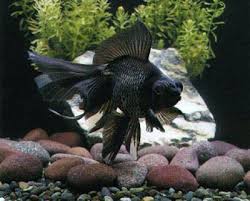
The Black Moor goldfish is a telescope-eyed variety of goldfish that, like most other fancy goldfish, is the result of generations upon generations of selective breeding.
The Black Moor has a distinctly velvety black, rounded body with long flowing fins and protruding eyes.

Black Moor temperament and care:-

Black Moors are one of the more hardy varieties among the fancier breeds of goldfish and are a good option for the novice goldfish enthusiast. However, their eccentric physical characteristics do call for some special considerations.
For starters, the Black Moor is an extremely slow swimmer and thus should not be kept with faster swimming varieties of goldfish, such as the common goldfish, the comet goldfish or shubunkins. Due to their poor eyesight, Black Moors usually take much longer to locate and consume their food, and the faster swimming varieties will often out-compete them for food. Sinking pellet type foods are often preferred for this reason rather than the floating varieties.
The Black Moor’s long, flowing fins are also known to attract the unwanted attentions of common goldfish and comets, which leaves them vulnerable to nipping and bullying. Great care should also be taken when aquascaping and decorating an aquarium with Black Moors. Their protruding eyes are extremely delicate and prone to injury, and any sharp objects or plants with jagged edges should be avoided in the Black Moor aquarium.
 

Breeding Black Moor goldfish:-

As with all goldfish, Black Moors can be induced to spawn with proper feeding and a sudden change in water temperature. This is done to mimic the conditions of spring, which is when natural spawning occurs with freshwater fish.  As with other goldfish, the Black Moor will readily devour its eggs and fry. So, the serious breeder should use spawning mats or a heavily planted aquarium to provide hiding space for the fry, or remove the parents as soon as the eggs are laid and fertilized.


Choosing Black Moor goldfish:-

 The body depth of an ideal Black Moor should be greater than 2/3 of the body length and the dorsal fin should be roughly 1/3 to 5/8 of the body’s depth. The Black Moor should have a double tail fin and the lobes should be well rounded and forked. The pectoral fins and pelvic fins of a Black Moor should be paired and should be of identical length.


Monday, August 26, 2013

Scorpion fish

Scorpion Fish Facts:-


Phylum:Chordata
Class:Actinopterygii
Order:Scorpaeniformes
Family:Scorpaenidae

Scientific Name:Scorpaenidae
Origin:Indian and Pacific Oceans
Diet:Omnivore
Size (L):14cm - 45cm (6in - 18in)
Water Type:Salt
Optimum pH Level:8.1 - 8.4
Life Span:10 - 15 years
Conservation Status:Least Concern

Colour:Brown, Black, Yellow, White, Red, Orange
Skin Type:Scales
Favourite Food:Fish
Habitat:Tropical reefs and rocky crevices
Average Clutch Size:6,000
Main Prey:Fish, Crabs, Snails
Predators:Large Fish, Humans, Sea Lions
Distinctive Features:Venomous sting and camouflaged body


A scorpion fish is a group of predatory, marine fish that are found amongst coral reefs and in shallow waters in the more temperate oceans. The scorpion fish is most closely related to the lionfish and is most commonly found in the Indian and South Pacific oceans.
There are more than 200 recognised species of scorpion fish, hiding amongst the ocean reefs and in artificial aquariums around the world. Scorpion fish are kept in tanks by numerous people because of their interesting appearance and behaviour.
The body of the scorpion fish is often cover in feathery fins that help the scorpion fish to camouflage itself into the surrounding coral. The colours and markings of the scorpion fish are also used to help the scorpion fish to hide.
Scorpion fish are nocturnal predators, and spend the daylight hours resting in a hidden crevice in the coral. Scorpion fish are also able to ambush their prey from this position and often catch small fish by surprise.
Scorpion fish are omnivorous fish and hunt small fish, crustaceans and snails on the coral reefs. Scorpion fish are able to stun their prey with their venom before eating it. Scorpion fish also use their venomous sting to fend off unwanted predators.
The scorpion fish is a very dominant predator in it's environment, and therefore the scorpion fish has very few natural predators. The human catching the scorpion fish to keep in tanks is the biggest threat to the scorpion fish along with habitat loss from the destruction of coral reefs. Large fish and sea lions are also known to hunt scorpion fish.
The female scorpion fish releases between 2,000 and 15,000 eggs into the water which are fertilised by the male scorpion fish. The scorpion fish pair then quickly hide so that their eggs can float into the ocean before being spotted by predators that eat the eggs. The scorpion fish eggs hatch in just 2 days and the tiny scorpion fish fry remain near the surface of the water until they are bigger. When the scorpion fish fry reach nearly an inch in length, they swim down into the ocean to join the reef community.

Sunday, August 18, 2013

Lionhead (goldfish)

Lionhead (goldfish):-

The Lionhead Goldfish is by far the most popular and well known of the dorsal less goldfish. Rather than having the long slender body of the Common Goldfish or the Shubunkins, the Lionhead Goldfish is one of the more rounded or egg-shaped fancy gold fish.
Lionhead Goldfish have a double caudal (tail) fin and a double anal fin. This goldfish variety is very similar to the Ranchu Goldfish, a variant that was highly developed Japan.The Lionhead can be distinguished by a less curved contour shape to its back. Also, its caudal fin is quite similar to that of the Fantail Goldfish, while the Ranchu has a tail fin that splays out to the sides, often being almost horizontal.
This goldfish was bred in China to develop a "hood" that depicts the image of the mythical Chinese lion-dog. The distinctive raspberry or lion's mane appearance of the Chinese Lionhead Goldfish have led to its common name 'Lionhead' Goldfish. The amount of head growth differs for each fish. For some the broad head, except for its eyes, mouth and nostrils, can become completely covered with fleshy growth (sometimes impeding their vision) while others will develop hardly any head growth at all.

These goldfish are available in a variety of colors. The solid metallic types include red, orange, chocolate, blue, and black. The nacreous types can be calico, bi-colored combinations of red and white or red and black, or tri-colored combinations in red, white, and black. There is also a red-capped variety with a bright red head and white body. Though pretty rare, there is also a long finned variety.
The Lionhead Goldfish is considered a rather delicate fish and is not recommended for beginners. Its swimming ability is cumbersome because of its rounded body which is further diminished by the lack of a stabilizing dorsal fin, a trait that is also seen in the Water-Bubble Eye Goldfish and the Celestial Eye Goldfish. Many of the elongated goldfish varieties like the Common Goldfish, Comet Goldfish, the Shubunkin, are not really good companions for the Lionhead Goldfish because they are fast swimmers and too competitive during feeding time. Better tank mates would be the similarly handicapped but less hardy Water-Bubble Eye Goldfish, Telescope Goldfish, and Celestial Goldfish. It won't win any races, but if kept with other slow-moving varieties the Lionhead Goldfish should get plenty to eat and do well.


SWORDTAIL FISH

SWORD TAIL FISH:-

Scientific Name: Xiphophorus helleri
Natural Habitat: Central America.
Common Names: Sword tail, Gold Tux, Red Velvet Swordtail, Lyretail, Black Velvet.
Beginner Fish: Yes, care level is easy!
Adult Size: Up to 5 inches.
Life Span: 2-3 Years.
Tank Mates: Keep with other livebearers or tetras of similar size. They are great for a peaceful community tank.
Tank Size: 10 gallons and up.
Tank Region: Everywhere.
Water Temperature: 72°F – 82°F
Water pH: 7 – 8
Feeding: Flakes, freeze dried and live foods. They are omnivores but require some greens in their diet.
Gender: Male has the long “sword-like” anal fin.

The Sword tail is a very popular freshwater tropical fish. I have kept many swordtail’s in the past and have always enjoyed watching them. They come in many different colors just like the platy fish. It is also a very hardy fish that can adapt easily which makes it a great choice for beginners!
Swordtail’s are livebearers which means that the baby fish come out free swimming. When breeding this fish, they are similar to the guppy in the way that they give birth about every 28 days.
When setting up a tank for swordtail’s make sure to provide plenty of swimming room and some hiding places. Your tank should be at least 10 gallons. When mixing swords, try to keep 1 male per 2 females. This is known to reduce aggression. They will accept many different types of fish foods, but tropical flake foods for a balanced diet are probably you best choice.

Tuesday, August 13, 2013

Blue morph

 BLUE MORPH:-


Pseudotropheus elongatus OrnatusGeneral Body Form:
 
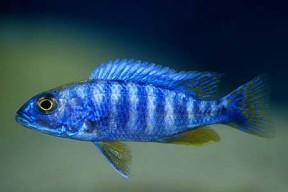
Long and thin for an Mbuna, the body is very slender. The males are Blue with dark bars and females are pale yellow with a hint of blue and sport a nice black dorsal fin.

Coloration:
 
Pseudotropheus elongatus Males have the pronounced egg spot on the anal fins. The male are cobalt blue with dark bars and females are pale yellow with a hint of blue. The dominant blue male will cause the submissive male to turn yellow similar to the female coloration. The only way you would know the difference between these submissive types is when they reach adult maturity. The males will be bigger in size then the females. Males are about 4-5 inches and females are 3- 3.5 inches in length.

Pseudotropheus elongatus OrnatusMaintenance:
    These fish are a nice addition to any mbuna tank. They are best kept in larger groups to spread aggression, as males can be quite belligerent. Territorial males dig a small tunnel or guard a rock as a territory. Females are more docile and may stay together but rarely school together. To maintain a good environment that duplicates the wild lets start with the water. The vital substance your fish will be in for their existence. Malawi cichlids come from water that is much alkaline {PH 7.5 to around 8.8} yet has relatively soft to medium hard water. Therefore an attempt should be made to duplicate these conditions in the home aquaria. To obtain a high PH in the home aquaria is to use a material that will naturally buffer the PH high. The most common material to use is crushed coral sand/gravel that is either placed in the substrate or in the stocking container to be placed in the filter {s}. The coral leeches minerals that raise the PH. Other materials like Crushed shell {oyster shell} can also be used. Another option is to use rocks, like limestone. The advantage of this option is that the rocks provide decoration, shelter, territorial markers. Spawning sites and maintain ideal water conditions by raising the PH of new water used in water changes. Lake Malawi cichlids do not stand high temperatures very well. Locate the aquarium away from sunny windows, space heaters etc. Even if you live in a warm climate it is recommended to use an aquarium heater in your home aquarium as this helps prevent fluctuation of water temperatures which lead to stress in the fish.

    Breeding:
      Maternal mouth brooders, the fish are not hard to spawn. Females hold for about 25 days. Males should be about 4- 4.5 inches and females 3.5 inches when fully matured. Sexual maturity is about 3 inches. Come spawning time the male does a little dance, or jittering, in front of the females and if any are ready she will follow the male into the breeding pit. The male will then scrape his anal fin on the rocks to show the female a good place to lay her eggs. The female will follow lay her eggs and then pick them up quickly. She does this a number of times and as she picks up her eggs the male rubs his egg spots on the rocks as well. The male does this to entice the female to try and pick up his egg spots also; when she tries he will release sperm into her mouth to fertilize the eggs. This process takes but a few hours. The fry hatch in about 21 days. Typical clutches range between 10-20. Raising the fry is very easy. Crush some regular cichlid flake food and feed twice daily. Also spirulina flakes as well. They grow pretty quickly.


Silver Arowana:-

Minimum Tank Size: 250 gallons
Care Level: Moderate
Temperament: Semi-aggressive
Water Conditions: 75-82° F, KH 1-8, pH 6.0-7.0
Max. Size: 3' 4"
Color Form: Black, White
Diet: Carnivore
Origin: Colombia, Peru
Family: Osteoglossidae


overview

The Silver Arowana, or Arahuana, is known by many alternate names, sometimes making identification tricky. Scientifically, it is most often called Osteoglossum bicirrhosum, but one may also hear reference to O. vandelli, or Ischnosoma bicirrhosum. Among the group known as band fishes, the Silver Arowana is considered a true bony fish. Indigenous to the flood plains of the Amazon River Basin in South America, the Arowana can reach an intimidating 47 inches in the wild, and is often too much for all but the advanced freshwater aquarist to manage. It can survive short times out of the water breathing air by utilizing its swim bladder. The Silver Arowana prefers a 250-gallon tank with a fine gravel bottom, loosely planted, and soft, peaty water with lots of open space above for swimming. The aquarium must be fitted with a tight, heavy cover because the Arowana will jump, particularly when after prey.
After breeding, the male Silver Arowana is responsible for carrying the large eggs in his mouth where they mature in 50 to 60 days. When young, these fish are easily harassed by more aggressive species such as Cichlids. Knifefish, large Plecostomus, Catfish, and Ornate Bichirs make good tank mates for the Silver Arowana.
A carnivore, the Silver Arowana will eat other smaller fish, water fleas, mosquito larvae, as well as freeze-dried ocean plankton, krill and pellet foods.
 
Approximate Purchase Size: Small: 1-1/2" to 3" Medium: 5" to 7"